Mostrar mensagens com a etiqueta Publicações. Mostrar todas as mensagens

sexta-feira, 27 de dezembro de 2024

New Ceramics 1 / 2025


An Interview with Monika Grass

1.I know your work since many years, have seen huge wall panels, in different colors and shape. Last time in Portugal, at the AIC/IAC Congress 2024. How did you start with this way to work in ceramics?

It was all unconscious. The next thing I knew, I was already in the art world. I studied ceramics for three years at the Soares dos Reis Art School, but it never really interested me because it was so closely linked to industry, and I became increasingly interested in photography. When it came time to go to university, I didn't want to pursue sculpture because photography was calling out to me. I ended up not going to any course, photography was private and there was no money to pay for the course. So I set up my own little studio, still at my parents' house, and started making my first ceramic pieces. I was trying to find interest in what I had studied for three years, but I wasn't satisfied with the results. One day I received information that there was going to be an intensive course in sculpture and ceramic murals with the sculptor Arcádio Blasco in Coimbra, Portugal. I took the course and discovered another world in ceramics, I realized that there was another world after all, that ceramics is just a material with which you can do almost anything. From then on..... went on to break new ground. I did other specializations in Spain with Emilio Galassi, spent a short time working in the studio of the master Arcadio Blasco and never stopped. I was hooked. I admit it, it's my addiction 😊 😊.

2. Are you born as a creative person? Working with clay from childhood?

As I said before, it was all very unconscious.  I never had any relatives connected to the arts, much less ceramics, so I didn't grow up in that world, and perhaps that's why I never felt like I fit in with the so-called “normal” world.

3. Can you explain the materials you use, the firings - and why did you choose “clay“ in your special way!

In the early years I worked with earthenware, then I started working with stoneware and occasionally with porcelain. Stoneware is my material of choice, with which I have developed my ceramic sculptures and murals. I gave up glazing for good in 2005. I don't identify with them at all in the works I've developed. I like to work with the natural colors of stoneware, with different grain sizes, I buy some colors and then mix them to get more colors and gradients. Occasionally I work with porcelain, but it's not my favorite clay, unless I'm in China, when porcelain is the clay of choice. I'm increasingly fond of the idea of mixing clays with different behaviors, so that later, in my wood-fired kiln, I can obtain more shades and “defects” in the piece. A kind of challenge between me and the clay, with the fire and smoke having the final say. I was taught that with ceramics there are surprises.... so let them be real surprises :-) :-) !! In 2005 I also started working with a wood kiln and it's the only kiln I have. I produce the pieces in my studio in the center of Porto, pack them raw and drive 250 km to my wood kiln, which is in a small village in the interior of Portugal, in Bragança.  Only when I'm in an artist's residence do I adapt to the kilns in the space.

  4. It´s hard work with the big panels, but you do also work on beautiful smaller pieces:

     - what’s the reason/the idea behind - they look so different...?

Although I work on a larger scale than we usually see, I still feel that my works are small. My goal is to create large-scale murals and sculptures, but to achieve this, I would need resources and, above all, clients willing to invest in these proposals.

In Portugal, the tradition of tiles serves as a starting point for the creation of my murals. From there, I try to go one step further, transforming these initial references into volumetric forms, creating works that expand and gain presence in space. My work is based on essential themes: space, habitat, the mountain, the valley, the path, the garden, the territory - in short, the environment that surrounds human beings and the settings that have accompanied them since their earliest origins. I also draw on deep and universal feelings, such as falsehood, love, disappointment - emotions that are so intrinsic to the human condition.

The drawings that make up my works have a language marked by simple lines, always in search of a harmonious rhythm in the composition. The repetitions of elements create patterns that gradually recreate geometries that fade with faded colors, the result of the action of fire. My intention is to explore rough textures and brittle roughness, reminiscent of geological formations, such as rocky or sedimentary overlays, imitating the stratigraphy of the earth. In the end, they often look like paintings.

In recent years, I have dedicated myself to investigating climate change, using water as a central theme in many of my works. This is the main focus of my production in the studio. However, when I take part in artist residencies, I always try to absorb the local culture and context to create new works. Recently, I had the opportunity to be in China again, where I produced works with a different approach. The immensity of the garbage and the disparities between social classes were the issues that drove my work, serving as a point of reflection and criticism on the contrasts present in that society.

5. Besides technical aspects, - what is the inspiration for your highly aesthetic ceramics. What is your intention - your inspiration?

It has more to do with geology, territory, land-use planning, human relations and not forgetting the tile tradition we have. With regard to what I see on Earth, the aim is to record what catches my eye and what I would like to see continue to exist. We're successively destroying everything, we still think we're superior to all beings on earth and that's why many of the works deal with human relationships, but in a more intimate, personal way. The ceramic murals I make are based on tiles, but with volumes and without glazes. I hope you feel both well-being and discomfort in some of the works. 

6. For 20 years, Sofia has represented Portugal at international symposiums in countries on several continents. How important is the experience with other cultures and artists in your work? Any you'd like to highlight?

It's through these symposiums and residencies that I grow. Every time I go abroad on business, I become a sponge. I always want to absorb everything that surrounds me, cultures, people, the natural or urban environment. Big cities don't seduce me, I can't absorb much because there are already cultural influences everywhere, but when these symposiums or residencies are in cities or towns, everything I feel is very positive. And seeing what other artists are doing and exchanging ideas is also extremely important to me. I've had very good experiences in almost all of them, for various reasons, but Gmunden, Austria was perhaps the symposium that brought together the most qualities, as well as Jingdezhen, China and Keskemét, Hungary.

7. Sofia is part of a generation of artists who have reclaimed ceramics for the major arts, looking at it beyond the conventional decorative dimension. How do you see the evolution and current state of ceramics in Portugal and the way it is valued (or not) compared to other arts?

I feel like I'm only halfway through everything I still want to do. I want to continue producing work, face new challenges, work more and more on a larger scale, for specific locations, have more exhibitions, do artistic residencies around the world, to grow as a person and as a ceramicist. And to get ceramics established in the world of contemporary art. It's a difficult place to be accepted, but I fight for it every day.

In Portugal? Yes, there are very few of us who work with ceramic material for sculptural works and who have technical knowledge. I've never liked making bibelots. I've always been fascinated by the idea of exploring the material to the limit. And the more I work, the less I know about ceramics. Ceramics is in fashion, every day I see workshops opening, selling bibelots and giving training.... But it's all a lot of hype.

Ceramics in Portugal has a long way to go. We're light years behind most countries and there isn't even a degree in ceramics in Portugal.

6. You are member of IAC/AIC - what are you expecting for yourself / the future of this organization?

I was the first Portuguese to join the academy in 2013. I was already aware of the opportunities and events organized by the academy, thanks to conversations I had with my master, Arcádio Blasco. It was precisely he (along with Rafa Pérez and Alberto Hernández), who recommended that I join the academy, saying that I had already proven my worth and merit to join the IAC. Unfortunately, when I received the news that I had been accepted, Arcádio had already passed away, which makes my presence at the academy a tribute to him.

I am, however, very critical of the direction the academy has taken. I'm concerned about the entry of many people whose artistic quality is, to say the least, questionable. What I feel at the moment is that it's enough to pay an annual fee and get a few subscriptions to be admitted, as if it were a “golf club”. In other words, quality and merit, which were once fundamental criteria for selection, seem to have lost their importance. I know several good artists who are leaving the academy for this reason. It's always better to be fewer but good than many and bad.

I hope this scenario changes. That the academy recovers its selection criteria, so that members feel truly motivated to value their work and contribute to the development of the institution. I believe that the academy should promote and support its members more actively, creating an environment in which everyone feels encouraged to stay in the institution and collaborate with each other.

segunda-feira, 29 de abril de 2024

The Spell of Sofia Beça Ceramic Artwork


While preparing a review for Terrart magazine (number 64, 1st semester 2024, Barcelona, p. 60-61), I have had the great pleasure of getting to know the work of Sofia Beça (Porto, 1972), one of the great ceramists of Portuguese lands, who is developing her activity, especially in the field of sculpture and murals made of fired clay.

Through the work of such a simple and humble material as clay -apparently only with her hands, but in reality -with her brain and heart, in unison- she is capable of recreating captivating spaces through the magic of her art -where the ceramic element- becomes the real protagonist, inviting the delight of all the senses. For, the contemplation of her works allows us to feel -caressing her pieces- perceive with the touch, the textures of the finishes chosen by the author herself, while visually she introduces you into the small world of plastic beauty -simply natural and human.

After a magnificent formative preparation in the specialty in the field of ceramics, at the Soares dos Reis School of Decorative Arts in her native city, in the late nineties and other specialization courses: Raku and especially sculpture and murals, under the mastery of great teachers such as Emidio Galassi and Acadio Blasco, the latter, considered by herself as her great master, she pursued her path that she had chosen by vocation, steadily with perseverance, tenacity and enthusiasm, tracing, thus, a career path based on fundamental principles that distinguish her for her talent and excellence in the results achieved. She is currently a member of the International Academy of Ceramics.

Since 1997 he has been exhibiting successively - individually and collectively. One of the first was at the Museum of Pottery of Barcelos, later exhibiting her works in several renowned galleries, which we mention below, as well as in museums dedicated to the ceramic theme in Portugal, Spain, the Netherlands, etc. Precisely because of her participation in other events, collectively - both in exhibitions, symposiums and international biennials, she has deserved the recognition of being one of the Portuguese ceramists with more international projection. Her work has been present in Japan, Argentina, France, South Korea. Austria, Tunisia, Egypt, Poland, Germany, Denmark, China, Latvia, Turkey, Greece, Italy, Slovenia, Russia, Hungary, ... even with commissions to beautify some public spaces, all over the planet.

She has been awarded a large number of prizes and recognitions, since 2002, especially in various competitions in the Iberian Peninsula, international ceramics competitions, etc., some of them shared with other artists.

In general, he delights us with a very careful work, technically impeccable, inspired by vital facts - intrinsically human activities - such as walking or wandering, following the earth as a common thread, not only for the raw material used, but also as his own idea - source of inspiration - from which emanate the slogans, meticulously chosen to make many of his works. In fact, all of them are linked to a theme that imbues them with meaning, in addition to giving them a life of their own that can be perceived by those who contemplate them with sensitivity and desire to contact with authentic art.

Selecting some examples, we refer to space, habitat, mountain, valley, path, garden, territory ... in fact the envelopes of the human being and its scenarios from its most remote origins.

Now, well, it is also inspired by feelings, such as falsehood, love, disillusionment, ... so intrinsic to human life itself.

Technically, he uses stoneware as raw material, which, once worked, is fired in a wood-fired oven. The designs, in general, of simple outline, always looking for a compositional rhythm that is reached harmonically as if it were a musical piece. In his works, the repetitions of elements are interspersed in a rhythmic and harmonious way, recreating geometries of blurred coloration. In this way, the chromaticism and tonalities are achieved by the action of fire, always, eagerly inquiring, rough textures, brittle roughness, similar to many of the geological formations, such as rock or sedimentary overlays, thus reproducing the sequencing of a stratigraphy.

Skill, mastery of technique and exquisite taste, essentially the result of approaches, ideas meticulously calibrated through a deep reflection on the human in our small planet, its weaknesses, but also showing how sublime a small work of ceramic art can be.

Margarida Genera i Monells

Prehistorian and archaeologist


quarta-feira, 30 de janeiro de 2013

Novo catálogo Online


Os catálogos estão sempre a ter que ser actualizados, ou porque há trabalhos novos a apresentar, ou porque deixa de fazer sentido continuar a apresentar trabalhos que já não estão disponiveís, ou então porque nos pedem informação acrescida. Com este catálogo em bilingue, podem ver os trabalhos que estão disponiveís no momento, acompanhados de alguns textos que foram sendo escritos e que podem ajudar (ou não) à compreensão do meu trabalho e ainda algumas publicações que foram sendo feitas ao longos destes anos.

http://issuu.com/sofiabeca/docs/sofia_be_a_-_ceramica?mode=window

quinta-feira, 12 de abril de 2012

Sofia Beça- "Cerámica y sentido" por Alejandro J. Ratia

A exposição "Arcadio Blasco - maestros de la cerámica y sus escuelas", continua patente no Museu de Cerâmica de Muel, Zaragoza, até dia 2 de Maio. Como também já aqui referi, nesta exposição estão obras de Arcádio Blasco e dos seus "discípulos", Alfonso D´Ors, Jesus Castañon, Madola, Sofia Beça, Teresa Gironés e Toni Soriano.

Para esta exposição foi editado um bom catálogo das obras expostas, de obras públicas dos autores e vários textos.
Fica aqui um dos textos, da autoria do crítico de arte Alejandro J. Ratia, sobre o meu trabalho.
Espero que desfrutem da leitura. Eu desfrutei das conversas que tive com Alejandro para dar neste texto.

CERÁMICA Y SENTIDO
“No me complacieron nunca las cosas ornamentales ni las convencionales, por eso entendí que la cerámica que puede colocarse sobre una mesa, y funcionar como un bibelot, no me interesaba, porque acaba por ser vista como un objeto decorativo y no como una escultura”, me cuenta Sofia Beça. Sus obras no están hechas para lucir sobre una mesa, ni tan siquiera para mostrarse sobre un pedestal. Como dijo Antonio Vivas, esta artista “representa la fuerza de la nueva cerámica portuguesa, más desinhibida, más libre, inclusive provocadora, pero siempre impactante en murales e instalaciones”. Sofia Beça ama trabajar sobre espacios concretos, lo ha hecho en Alcora, lo ha hecho en Muel, etcétera, y sus trabajos tienen, en muchos casos, un carácter abierto, que pide la colaboración de otros artistas, de otros medios, o del espectador, e incluso de los elementos (el fuego, el aire…), y suelen incorporar una acción. Sus obras no se quedan satisfechas con la simple mirada. Incluso cuando no se destinan a un espacio público, su modo de utilizar la sala de exposición será heterodoxa, porque muchas veces van directamente al suelo, y no parece que se exhiban allí, sino que ocupen, que se extiendan por el suelo, o por la pared. Es una puesta en escena; nada retórica, por cierto, pero puesta en escena. El trabajo en el campo, o la integración específica en una arquitectura son sus ideales. Como entre los clásicos del Land Art, la exhibición en una galería o centro de arte tiene un punto de exilio. Es el viejo problema de site / non‑site de Smithson llevado al mundo cerámico.
Entre las influencias, entre los maestros de Sofia Beça, están algunos de los grandes de la cerámica contemporánea, y uno muy especial, Arcadio Blasco, con quien mantiene una estrecha relación desde 1998 –cuando se conocieron en Portugal, donde el ceramista daba un curso–, una relación que ha llegado a ser paterno filial. Pero como creadora inquieta, sus influencias también llegan de otros ámbitos, del ámbito general del arte, del que (como sucede con Arcadio Blasco) ella no acepta desligarse. Un artista como el británico Andy Goldsworthy, con sus intervenciones poéticas en la naturaleza, con elementos naturales, tomados en bruto como piedras, o bolas de nieve, o un escultor como su compatriota Alberto Carneiro forman parte de sus referentes.
El mundo de los árboles, que es también el mundo de Carneiro, aparece de un modo a un tiempo explícito y elíptico en su instalación Floresta Portuguesa, un bosque que es un no‑bosque, un bosque del que sólo quedan los vestigios o tocones. Con él, Sofia Beça alude al problema de la deforestación de su país. Las piezas con que recrea este bosque esquilmado las hay de dos colores, castañas y negras, árboles talados y árboles quemados. Esta obra nos sirve de ejemplo para señalar las peculiaridades del trabajo de la ceramista. La primera peculiaridad es su interés por el mensaje, la cualidad del barro como instrumento. “No tengo ninguna duda –asegura– de que, cuando meto las manos en el barro estoy transformando la materia en algo que me interesa transformar, que quiero transmitir un mensaje. Aunque sólo tenga significado para mí.” En el caso de Floresta Portuguesa este mensaje llega a ser explícito, conteniendo una denuncia social o ecológica, pero, ante todo, es un mensaje poético. Ese bosque devastado es un daño colectivo y particular, a un tiempo.

Desde el punto de vista plástico, la obra que he citado, como todas las suyas (o al menos las más recientes), no maneja otros colores que los que derivan del propio material base, al que sólo se suma la acción del horno. Un lenguaje cromático inmediato, por lo tanto, de comunicación directa entre material y destinatario, con la ceramista como mediadora. En esta mediación, casi mágica, interviene, como elemento clave, la confección artesanal y cuidada de todos y cada uno de los elementos de esas puestas en escena, cada tocón cerámico, en este ejemplo, piezas que suelen ser intercambiables desde un punto de vista gramatical, elementos reemplazables, algo arbitrarios en número, pero que son elaborados uno a uno y con sumo cuidado, como si fueran únicos, cosa que son. En Floresta no son muchas las piezas, pero en obras como És a minha onda, se multiplican. Son ahora espirales de barro, en un proliferación digna de pólipos.
Sofia Beça se justifica: “podría hacer el mismo trabajo con moldes, pero para mí, dejaría de tener cualquier encanto. Cada pieza, aunque parezca igual que las otras, debo hacerla yo, si no, tengo la sensación de que no es mía. Y por eso me encanta, también, usar el horno de leña, porque dos piezas gemelas terminan distinguiéndose por el color”. A ese horno de leña de nuestra ceramista, Karin Somers le atribuye un “comportamiento temperamental”, que enriquece a sus “despojadas piezas con manchas de humo y tonos de reducción”.

Se da en esta artista la doble condición de constructora y fabricante. Constructora de relieves e instalaciones significantes. Fabricante de las piezas con las cuales las construye. Los niveles de lectura de sus obras, por ello mismo, se duplican. Las piezas, que como letras, o como notas, las integran, aportan un significado propio. En És a minha onda, son ondas que hablan de una existencia inconsistente, en la que damos vueltas sin cesar. Y de algo parecido hablan las mariposas de Borboletear. Ella misma se refiere al arte en esos términos de incertidumbre y fragilidad: “Y también (pienso) que el arte –me explica– es como las mariposas y las personas, en realidad todo es efímero. Pensamos que andaremos por esta vida mucho tiempo, pero sólo estamos de paso. Y el arte termina siendo lo mismo, un momento efímero”. Efímero pero significativo.

Tal como escribió Joaquín Vidal, los elementos que fabrica son “letras de barro que trabaja delicadamente, con paciencia y mimo, hasta que adquieren la apariencia y el significado de las letras de los códices antiguos”. Y añade este autor que “nada carece de significado o tiene un sitio aleatorio. Las pequeñas piezas se disponen sobre sus soportes en función de un lugar y un tiempo vividos, agrupándose, abrazándose y separándose con color o esperanza.” Sofia Beça fabricante y artesana, amiga de lo efímero, pero también constructora. Porque queda ese sentido esencial que aporta, como escenificación, el conjunto de las piezas de las que hablábamos, el texto escrito con esas letras, la música escrita con esas notas. 

Concluiré con una frase suya: “no me preocupa que la cerámica pierda protagonismo –dice–, porque lo que me interesa es el mensaje que intento transmitir”. Se trata de una cerámica entendida como útil de escritura, no como un fin en sí misma. Pero el texto que se escribe, como todo texto poético, es uno con la materia con la que está escrito, con la música de sus palabras, con la esencia de la propia cerámica, que es la que nos habla.

Alejandro J. Ratia
Critico de Arte
Dezembro de 2011

quarta-feira, 25 de agosto de 2010

O que começa a surgir sobre a exposição

Já lá vão uns meses em que a entrevista foi feita, estava eu a começar a preparar a exposição. Saiu agora o artigo, na Revista Casa Cláudia (nº272), para coincidir com a inauguração. Para ler o artigo basta clicar na imagem.

Também a revista cerâmica espanhola faz a devida divulgação
Alberto Andrés escreve no seu blog:

quarta-feira, 19 de maio de 2010

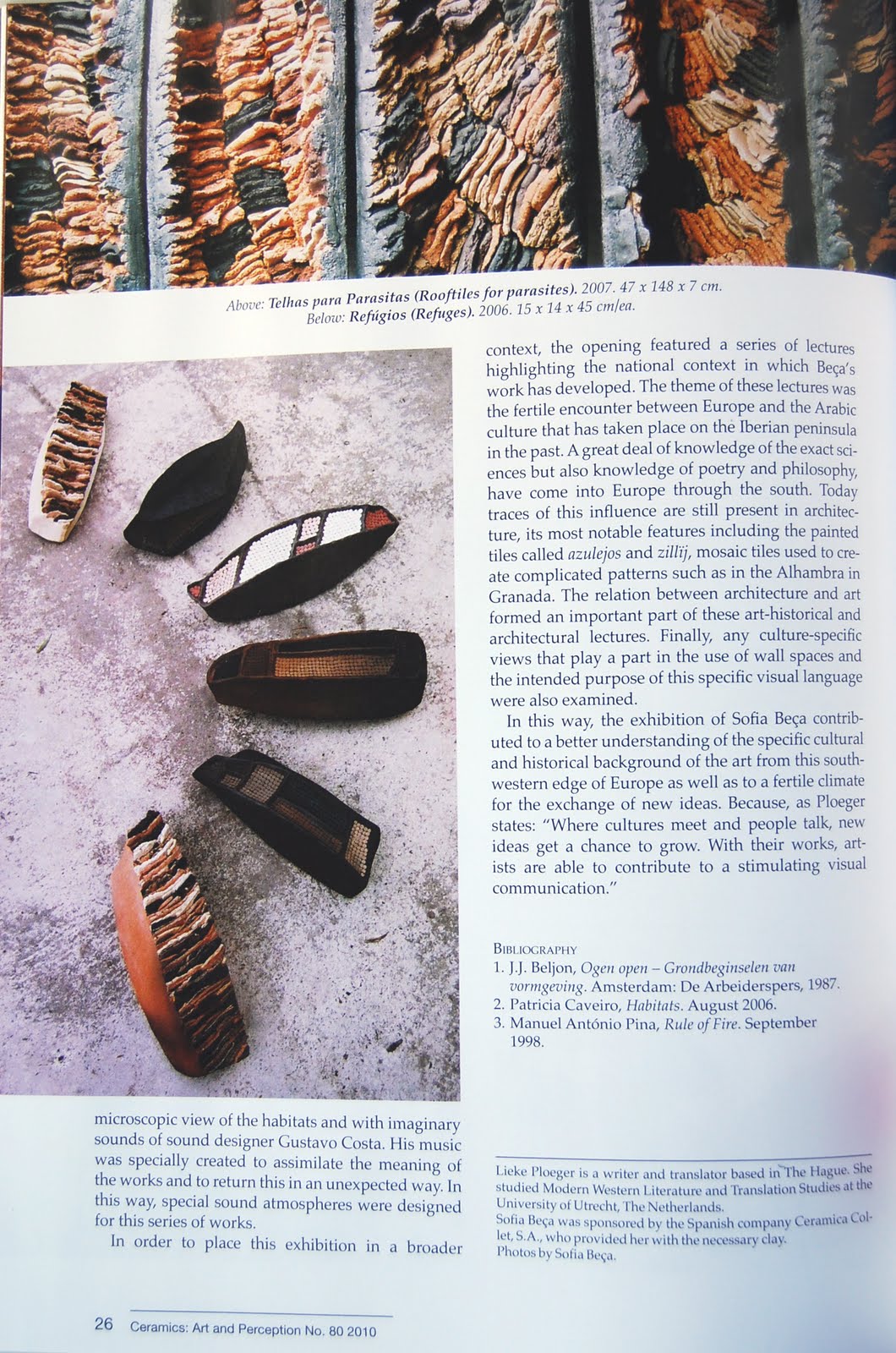
Artigo na revista Ceramics - Art and Perception


No último numero da revista americana "Ceramics - Art and Perception", publicaram um artigo sobre a exposição que fiz, faz agora dois anos, em Drathen, na Holanda, intitulada "From Womb to Tom". O artigo deveria ter saído na altura, mas mais vale tarde que nunca.
Para quem quiser ler em inglês, é só clicar nas imagens, para os que gostam de simplificar e aguentam um artigo longo, aqui vai a tradução:

A escolha de Paulien Ploeger
Enquanto recentemente algumas fronteiras da Europa desaparecem e a Leste estas se deslocam, a Sudeste a fronteira ainda é feita da água que separa a Península Ibérica do Continente Africano.
Durante a primavera de 2008, a De galley De Lawei, em Drathen, ofereceu ao público holandês a possibilidade de conhecer peças únicas deste canto da Europa.
A exposição "Do Ventre ao Túmulo - refúgios e habitats", apresentou as peças da ceramista Sofia Beça.
Esta exposições foi organizada por Paulien Ploeger, que foi convidada pela galeria para apresentar um evento surpreendente, tendo sido anteriormente responsável por projectos onde a arte da Lituânia foi o tema principal.
Com esta nova exposição, com a artista portuguesa Sofia Beça, surge de novo em destaque a arte de um país até agora desconhecido.
"Numa Europa em mudanças, isto é muito importante", diz Paulien. "Nós estamos conscientes da nossa identidade nacional e das diferenças regionais. É importante que essas diferenças sejam preservadas para prevenir que se perca esta rica palete cultural da nova Europa".
A exposição "do Ventre ao Túmulo - refúgios e habitats", mostrou o trabalho tridimencional de Sofia Beça. Esta ceramista recebeu em Dezembro de 2007 uma nomeação na Bienal Internacional de Cerâmica de Aveiro com a peça "Borboletear", exposta em Drathen. Também em anos anteriores recebeu idênticos prémios, no país e no estrangeiro. Participou no simpósio "Amakusa Ceramic Art", em Hondo, no Japão e representou Portugal no "VII Simpósio de cerâmica de Avellaneda", em Buenos Aires, Argentina.
O trabalho de Sofia Beça é elaborado a partir da tradição cerâmica portuguesa e dos seus interesses pessoais. Dois dos temas mais importantes da ceramista estão patentes na exposição "refúgios e habitats", materializando estes conceitos numa forma pessoal e a partir do seu historial. O uso das cores, com muito vermelho, lembra África e a terra espanhola e portuguesa.
O tema "refúgios" tem tudo a ver com a imagem ancestral do modo de vida do ser humano. Desde o início, o Homem escolheu as cavernas como o seu habitat, espaço que lhe dava a protecção ideal. Também nas crianças, que gostam de fazer cabanas e espaços para esconderem os seus segredos, é possível reconhecer estes instintos ancestrais.
Em todo o ciclo da vida de "do ventre o túmulo" é demonstrada esta necessidade animal e humana de criar refúgios.
O trabalho de Sofia Beça foi muito inspirado neste tema universal. Ela materializa refúgios de pessoas e animais de uma forma muito humorística e pessoal.
O segundo tema desta exposição tem a ver com a envolvente dos animais, os seus habitats. Também as pessoas cada vez mais criam espaços à sua volta para se protegerem da sociedade complexa de hoje em dia. Mas, neste ponto, parece que perdemos a noção da importância da natureza. Sofia Beça tenta, com o seu trabalho, dar forma à importância deste tema.
As instalações nos pavimentos e paredes em Drathen foram complementadas com as fotografias de Rui Costa, que nos deu um olhar microscópico dos habitas, e com o som de Gustavo Costa, cuja música foi propositadamente concebida para o evento.
Complementando a exposição de uma forma mais abrangente, foram efectuadas, antes da inauguração, duas conferências.
No que respeita ao percurso de Sofia Beça, uma das conferências se afigura mais importante, nomeadamente sobre a confluência do passado europeu com a cultura árabe na Península Ibérica. Muitos conhecimentos nas áreas das ciências, poesia e filosofia tiveram a sua divulgação pelo sul da Europa. Os vestígios desta influência são hoje visíveis na arquitectura, como está patente nos azulejos e "zillïj´s" dos murais da famosa Alhambra, em Granada.
A conferência abordou a relação entre a arquitectura e a arte cerâmica.
Desta forma, a exposição contribuiu para um melhor entendimento do passado cultural e histórico da arte do Sudeste da Europa, criando um ambiente fértil para a troca de novas ideias.
Como Paulien Ploeger afirmou "onde as culturas se encontram e as pessoas trocam ideias, a nossa mentalidade tem a possibilidade de florescer e os artistas participam, com o seu trabalho, para uma comunicação visual estimulante".

quinta-feira, 3 de dezembro de 2009

Céramique 14 na Revista Céramique et du Verre

No último número da revista Cèramique et du Verre, vem um artigo sobre o 6º Salão do Cèramique 14. Quem quiser ler o artigo é clicar na foto.

quarta-feira, 25 de novembro de 2009

Agradecimento

Quando coloquei a postagem sobre a publicação do livro "Contemporary Ceramics", não fazia a mínima ideia da reacção que essa publicação poderia ter. Para além de ter recebido comentários no blog, recebi dezenas de emails de vários cantos do mundo e até telefonemas. Alguns desses mails vieram de pessoas que me surpreenderam muito com o seu conteúdo. Por isso não posso mesmo deixar de fazer um agradecimento público a todos eles. Se a vontade de continuar a trabalhar já existia, agora mais do que nunca fico com essa responsabilidade. Obrigada a Todos.

segunda-feira, 23 de novembro de 2009

Livro "Contemporary Ceramics"


Chegou-me finalmente ás mãos o livro Contemporary Ceramics de Emmanuel Cooper da editora Thames & Hudson. Para este livro foram escolhidos 500 ceramistas de todo o mundo. Todos têm um pequeno texto sobre a sua obra e uma imagem. Sobre mim escreveram:

A powerfull sense of environmental concerns informs the works of artists Satoru Hoshino and Sofia Beça. Hoshino creates a convincing sense of growth in installations that seem to invade and take over gallery space to evoke a sense of the organic without replicating anyparticular aspect. Beça´s work makes allusions to such things as standing stones, objects that may be the result of natural activity or carefully created and placed by human endeavour. The use of earth colours, such as terracota and burnt brown, are the colours of earth, the reassuring, quiet tones of land."

Neste livro, para além de encontrar vários ceramistas meus conhecidos, foram também escolhidos Rafael Pérez e Thomas Weber, que participaram comigo nos Encontros Internacionais de Ceramistas em Boassas.

quarta-feira, 14 de janeiro de 2009

Publicações

Tudo indica que este será o ano das publicações que me digam respeito directamente.
Em Agosto passado estava previsto haver uma exposição da 1ª Bienal Internacional de Ceramistas Emergentes em Xi´an, China e eu tinha sido uma das seleccionada. Por questões financeiras da organização a exposição não se realizou fisicamente, mas está prevista, para a Primavera, a publicação de um livro/catálogo dessa exposição. Na altura fiquei desiludida por não haver exposição, mas na realidade o que fica como registo são os livros ou catálogos, por isso, provavelmente até foi melhor assim e não corri o risco de ficar com trabalhos perdidos ou partidos (e bem mais barato). A China não é propriamente aqui ao lado.

Também no ano passado fui escolhida para integrar no livro Contemporary Ceramics -International Perspective, de Emmanuel Cooper, da editora Thames & Hudson. Deveria sair agora no início do ano, mas recebi a informação da editora a dizer que já está finalizado mas que apenas será editado no Outono.

Vamos a ver se sempre aparecem os livros e com que qualidade.